

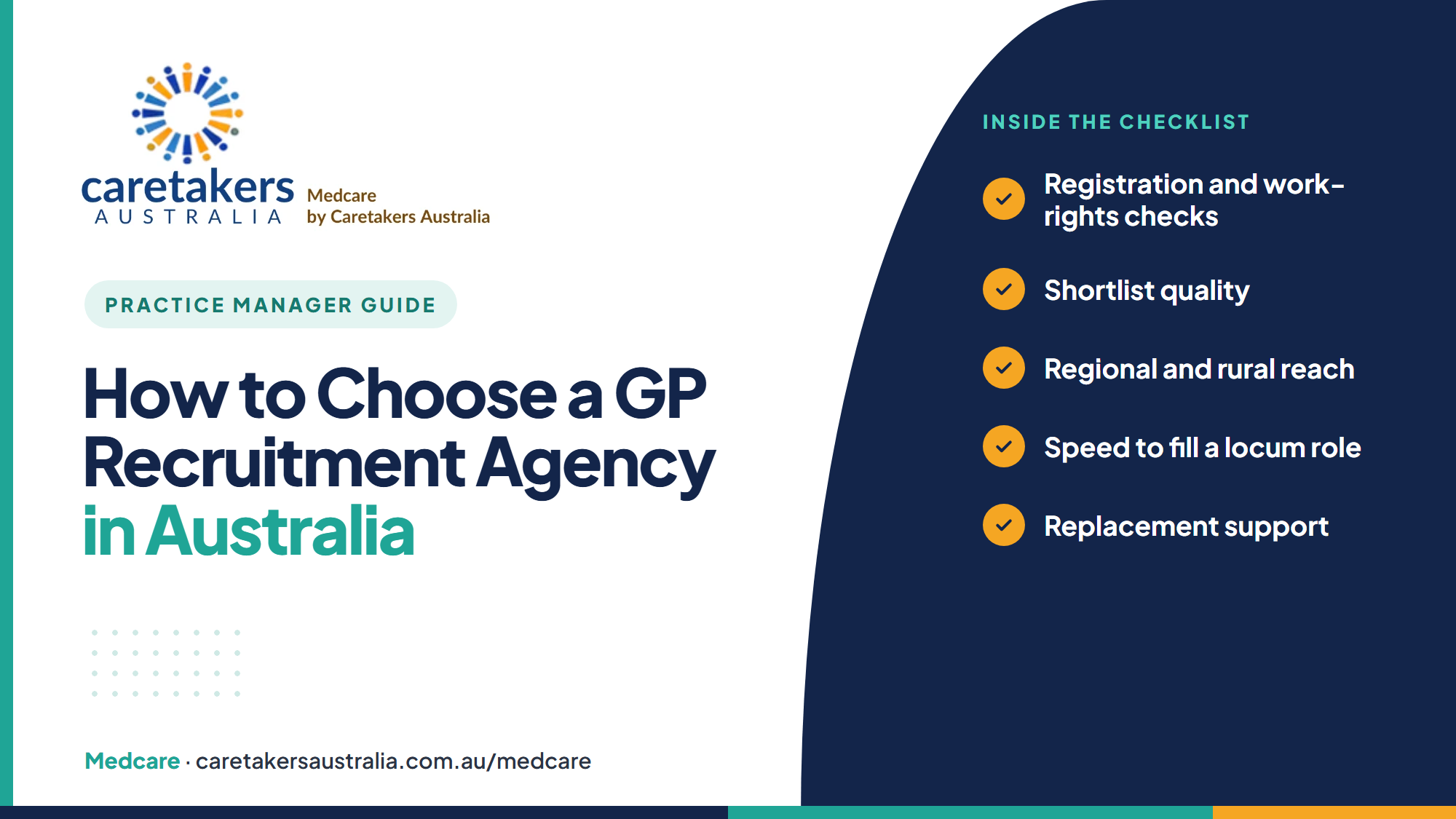
How to Choose a GP Recruitment Agency in Australia
When a GP resigns, goes on leave or a vacancy sits open for months, your patients feel it first. Appointment books fill up, other doctors carry the load and, in regional towns, people may travel a long way to see someone else. Choosing the right GP recruitment agency in Australia can shorten that gap. Choosing the wrong one can lose you weeks chasing paperwork and reading CVs that don’t fit.
This checklist is for practice owners, practice managers and aged care providers. It sets out the five questions to ask any GP recruitment agency in Australia before you sign, plus the checks you should still do yourself.
General information only. This is not legal, migration or employment advice. Always confirm current rules with Ahpra, the Medical Board of Australia, the Department of Health, Disability and Ageing, Services Australia and the Department of Home Affairs.
At a glance
- A good agency verifies a GP’s registration, qualifications, experience and work rights before you see their CV.
- You should get a short list of suitable candidates, not a pile of CVs.
- If your practice is regional or rural, ask how the agency works with the Distribution Priority Area (DPA) and the 10-year moratorium.
- Ask for realistic timeframes, and plan early for holiday periods.
- Get the agency’s replacement and communication terms in writing before you sign.
What does a GP recruitment agency in Australia actually do?
A GP recruitment agency finds, screens and presents doctors for your locum or permanent roles. A good one does much more than advertise. It should:
- understand your practice, your patient mix, your opening hours and your location
- look for GPs who suit the role, including doctors who are not actively job hunting
- check registration, qualifications, experience and work rights
- coordinate interviews, references and start dates
- help with the steps that come before a GP can see patients, such as Medicare provider number timing
Agencies work very differently, though. Some are job boards that pass on applications. Others screen closely and present only a few people. The five questions below help you find out which kind you are talking to.
Question 1: How do you verify registration and work rights?
This is the most important question to ask a GP recruitment agency. In Australia, a doctor must be registered with the Medical Board of Australia, through Ahpra, to practise. Ask the agency exactly what it checks and when. A thorough answer should cover:
- Ahpra registration. The Ahpra register of practitioners shows whether a doctor is registered, their type of registration, and any conditions or undertakings that limit their practice. Ask whether the doctor holds general, specialist, provisional or limited registration, because this affects supervision needs.
- Fellowship and qualifications. Confirm fellowship with the RACGP (FRACGP) or ACRRM (FACRRM), or where the doctor is on a pathway to fellowship.
- Professional indemnity insurance. The Medical Board’s registration standards require registered medical practitioners to have appropriate professional indemnity insurance arrangements.
- Work rights. For doctors on a visa, employers can check visa work conditions using VEVO, the Department of Home Affairs online service.
- Medicare access. Many overseas-trained doctors are subject to section 19AB of the Health Insurance Act 1973. This affects where they can provide services that attract Medicare benefits (see Question 3).
- References and experience. Ask how many referees the agency speaks to, and whether they are recent clinical supervisors or colleagues.
Even with a great agency, your practice remains responsible for who it engages. Check the Ahpra register yourself before a GP starts. It takes a few minutes, and it is good practice for accreditation against the RACGP Standards for general practices.
Question 2: How many CVs will you send me?
More CVs is not better. Every unsuitable CV takes your practice manager time to read, discuss and reject.
Ask the agency:
- How do you shortlist? Who decides a candidate is suitable?
- Do you meet or interview every GP before you present them?
- Will you tell me why each candidate fits this role?
- Do you ask my permission before sending my practice’s details to a candidate?
A strong answer sounds like “we send a small number of screened GPs who match your requirements, with a short note on each”. Be wary of an agency that sends dozens of CVs on day one. It usually means little screening has been done.
Question 3: Do you cover regional and rural areas?
Recruiting a GP for a regional, rural or remote practice is a different task from filling a metropolitan role. Ask the agency whether it actively places doctors in areas like yours, and how it does it.
Two Australian rules matter here:
- The Modified Monash Model (MMM). The Department of Health, Disability and Ageing uses MMM categories from MM 1 (major cities) to MM 7 (very remote) to classify how remote a location is.
- Distribution Priority Area (DPA) and the 10-year moratorium. Under section 19AB, many overseas-trained doctors and foreign graduates of accredited medical schools must work in a priority area to access Medicare benefits. For GPs, that priority area is a Distribution Priority Area. The 10-year moratorium runs from a doctor’s first medical registration in Australia, and exemptions and scaling may apply.
A good agency will know whether your location is in a DPA and which doctors can work there. This is especially important if you are open to an International Medical Graduate (IMG). Ask how the agency supports IMGs with registration and relocation. Strong IMG support widens your pool of suitable candidates. Read more about our IMG pathway support.
Also ask about the practical side of rural placements: travel, accommodation and orientation to the town. A locum who arrives to find no housing organised is not set up to succeed.
Question 4: How quickly can you fill a locum or permanent role?
No honest agency can promise a start date before it knows your role. Instead, ask what affects the timeline and how the agency manages each step. The main factors are:
- Registration status. A GP who already holds the right registration can usually start sooner than a doctor who is still applying.
- Medicare provider number. Services Australia issues a Medicare provider number for each practice location, so a new GP or locum needs one for your practice before Medicare services can be claimed there.
- Your onboarding. Software access, credentialing and orientation all take time at your end.
- Location and dates. Remote locations and popular holiday periods can take longer to cover.
If you need cover over Christmas and January, start the conversation as early as you can. For more practical steps, see our checklist on how to find a locum GP fast.
Question 5: What happens if a placement doesn’t work out?
Even with careful screening, a placement can end early. A GP may need to leave for family reasons, or the fit may simply not be right.
Ask the agency, before you sign:
- Do you offer replacement support if a GP leaves early? On what terms?
- Who is my contact if there is a problem during a locum placement?
- How quickly will you respond to an issue?
- Do you check in with both the practice and the GP after the start date?
Get the answers in writing. An agency that is confident in its screening will be clear about what happens when things change.
Other things to check before you sign
Beyond the five questions, a few more checks help you compare agencies fairly:
- Communication. Will you have one named contact who knows your practice?
- Specialty knowledge. Does the agency understand general practice, not just healthcare in general?
- Privacy. How does the agency handle candidate and practice information?
- Range of roles. If you also need nurses or aged care staff, can the same agency help? For aged care employers, see our aged care staffing page.
- Compliance knowledge. Can the agency explain the rules that apply to your setting? Our compliance hub brings key topics together.
Red flags to watch for
- Promises of a “guaranteed” GP by a set date before the agency understands your role
- CVs arriving with no sign of screening, or with registration details missing
- Vague answers about how registration and work rights are checked
- Pressure to sign before you have seen the agency’s terms in writing
How Medcare by Caretakers Australia helps practices find the right GP
Medcare by Caretakers Australia recruits locum and permanent GPs for practices, medical centres, aged care providers and hospitals across Australia. Here is how we work:
- Screened and verified candidates. We check registration, qualifications, experience and work rights before we present a GP.
- Only suitable candidates. You see GPs who match your role, not bulk CVs.
- Regional and rural reach. We focus on hard-to-fill regional and rural roles, including MM 2 to MM 7 locations.
- IMG support. We support International Medical Graduates with Ahpra registration and moving to Australia, which can widen your candidate pool.
Every placement is different, so the best first step is a conversation about your practice, your dates and the kind of GP who will suit your patients.
Frequently asked questions
What should I look for in a GP recruitment agency in Australia?
Look for an agency that verifies Ahpra registration, qualifications, experience and work rights before presenting candidates. It should send a short list of suitable GPs, understand regional and rural rules like DPA, give realistic timeframes and put its replacement support terms in writing.
How do I check a GP’s registration in Australia?
Search the Ahpra register of practitioners online by the doctor’s name or registration number. The register shows whether the doctor is registered, their type of registration, and any conditions or undertakings on their practice. Check it yourself before the GP starts, even if an agency has already done so.
Can an overseas-trained GP work in my practice?
It depends on their registration, visa and Medicare access. Many overseas-trained doctors are subject to section 19AB and must work in a Distribution Priority Area to access Medicare benefits, unless an exemption applies. Check your location on the Department of Health, Disability and Ageing DPA map.
How long does it take to recruit a GP through an agency?
It varies with the role, location, dates and the GP’s registration and Medicare provider number status. A locum who already holds the right registration can often start sooner than a doctor who is still applying. Plan early for holiday periods and remote locations.
Do aged care providers use GP recruitment agencies?
Yes. Aged care providers often work with healthcare recruitment agencies for clinical staff, including registered nurses and, where needed, medical practitioners. Choose an agency that understands aged care obligations as well as general practice.
Talk to Medcare about your GP vacancy
Need a locum or permanent GP for your practice, medical centre or aged care service? Tell us about your role, your location and your dates, and we will explain how we can help.
Call 03 9419 4814, email medcare@caretakersaustralia.com.au or visit our Find a GP page. We are available Monday to Friday, 8:30am to 5:30pm AEST, and reply within one business day.